MoMo - No.1 E-wallet in Vietnam
Buy Now
Redesigning the Buy Now Pay Later touchpoints to drive new activations.
Not interested in reviewing the UX process?
Khoyy
Payment Platform
M_Service


Pay Later Growth
+
K
New Users
Quantitative Impact
+
%
Internal SoF Share
Figures adjusted to preserve confidentiality; magnitudes and directional trends reflect actual results.

Explore the process
Project Brief

About MoMo
Launched in 2010, MoMo is proud to be Vietnam’s tech unicorn, offering a leading super-app financial platform that serves over 40 million users. It has become a cornerstone of the country’s Fintech and digital economy ecosystem.
About Buy Now Pay Later
MoMo Pay Later is a postpaid digital wallet product that provides users with a revolving credit line for everyday transactions. It features built-in flexible installment options, offering a seamless Buy Now, Pay Later (BNPL) experience similar to Affirm or PayPal Pay in 4 in the US.
Requirements
Target: Drive 350,000 new MoMo Pay Later activations

What are the factors responsible for the problems?
The Research
Survey
I ran an in-app survey with 380 users that surfaced 8 raw friction signals. Three filters narrowed those down to the hypotheses worth testing

Data tracking
After surveying 380 respondents, we committed to three hypotheses: Hidden Value, Placement, and Promotional Salience. Behavioral tracking on the Pay Later widget then surfaced the same signal independently — a collapse from 22.5% impression to 0.09% click — converging with one of the three. This cross-method agreement moves the hypothesis from plausible to strongly confirmed.

Disclaimer: To ensure confidentiality, the data has been blurred and adjusted.

Table 1: Pay Later Widget Conversion Funnel - Dec 2024 to Jan 2025
Finding
The three survivors: (1) Hidden Value, (2) Placement, and (3) Promotional Salience

How might we?
Ideate
Design Principles
How might we clearly present the approved credit limit to build trust and encourage users to activate MoMo Pay Later?
When users see their approved credit limit, it helps them feel more in control and confident in the product. This visibility reduces uncertainty and builds trust, which can increase the likelihood of activation. Without this information, users may hesitate or ignore the feature altogether.
How might we make promotional offers more visible and relevant to motivate unregistered users to explore MoMo Pay Later?
Promotions are a strong trigger for user interest and action, especially for new services. If promotional messages are hidden or vague, users are less likely to notice or feel compelled to engage. Making offers more visible and contextual can drive higher exploration and activation rates.
How might we improve the placement and messaging of MoMo Pay Later at checkout so it stands out and drives engagement?
Currently, Pay Later is placed beneath a crowded payment carousel with generic messaging, making it easy to overlook. Improving its visual prominence and using clearer, benefit-focused messaging can help capture user attention and increase interaction with the feature.
Draft some viable solutions to tackle the situation!
A/B Testing
A/B Testing - Hypothesis 1: Hidden Value
Timeline: 07/01/2025 - 14/02/2025
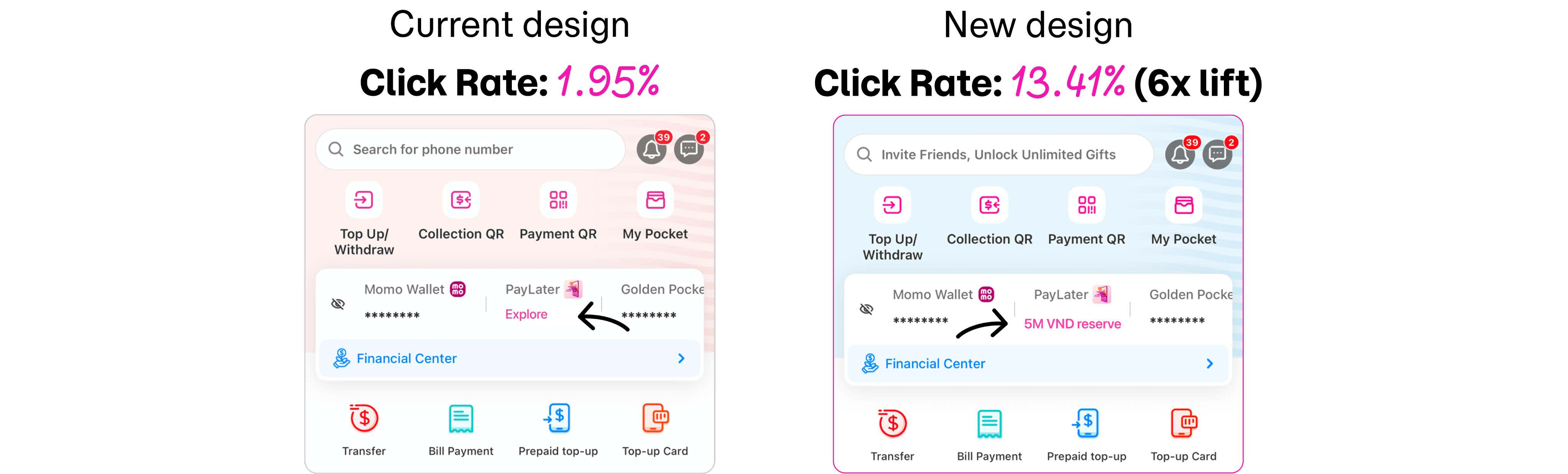
Hypothesis 1: Showing pre-approved credit limit to unregistered users will increase click-through on Pay Later CTA by making the offer's tangible value immediately visible.
Based on the hypothesis that users are more likely to take action when product information is clearly presented, we conducted an A/B test on two user segments (those who had not yet activated MoMo Pay Later) to evaluate the impact of showing the approved credit limit.
→ Results showed users who saw their approved credit limit had a click-through rate nearly 6× higher (13.41% vs 1.95%) than those who did not.
Disclaimer: To ensure confidentiality, the data has been blurred and adjusted.

Table 2: A/B Test Results – Impact of Displaying Approved Credit Limit to Unregistered MoMo Pay Later Users
A/B Testing - Hypothesis 2 & 3: Placement & Promotional salience
Timeline: 07/01/2025 - 14/02/2025
Hypothesis 2: Users never engaged — the entry point was buried.
Hypothesis 3: Users saw Pay Later but had no reason to act — no visible benefit or reward
Users who saw the promo label had click-through rates 1.3× to 2.6× higher across 4 of 5 services — with Airline and Billpay showing the strongest lift (2.2–2.6×), while the Data service showed no lift. Promo label effect varied by service category — strongest on Airline/Billpay, none on Data. Further segmentation analysis scoped for follow-up.
Disclaimer: To ensure confidentiality, the data has been adjusted.

Table 3: A/B test results comparing click-through rate on Pay Later entry point, segmented by service and by whether the promo label was visible. Test window: 7 Jan – 14 Feb 2025 (~6 weeks).
Perfect timing: the revamp let us bundle all three validated fixes.
A Parallel Redesign
Meanwhile, a separate revamp
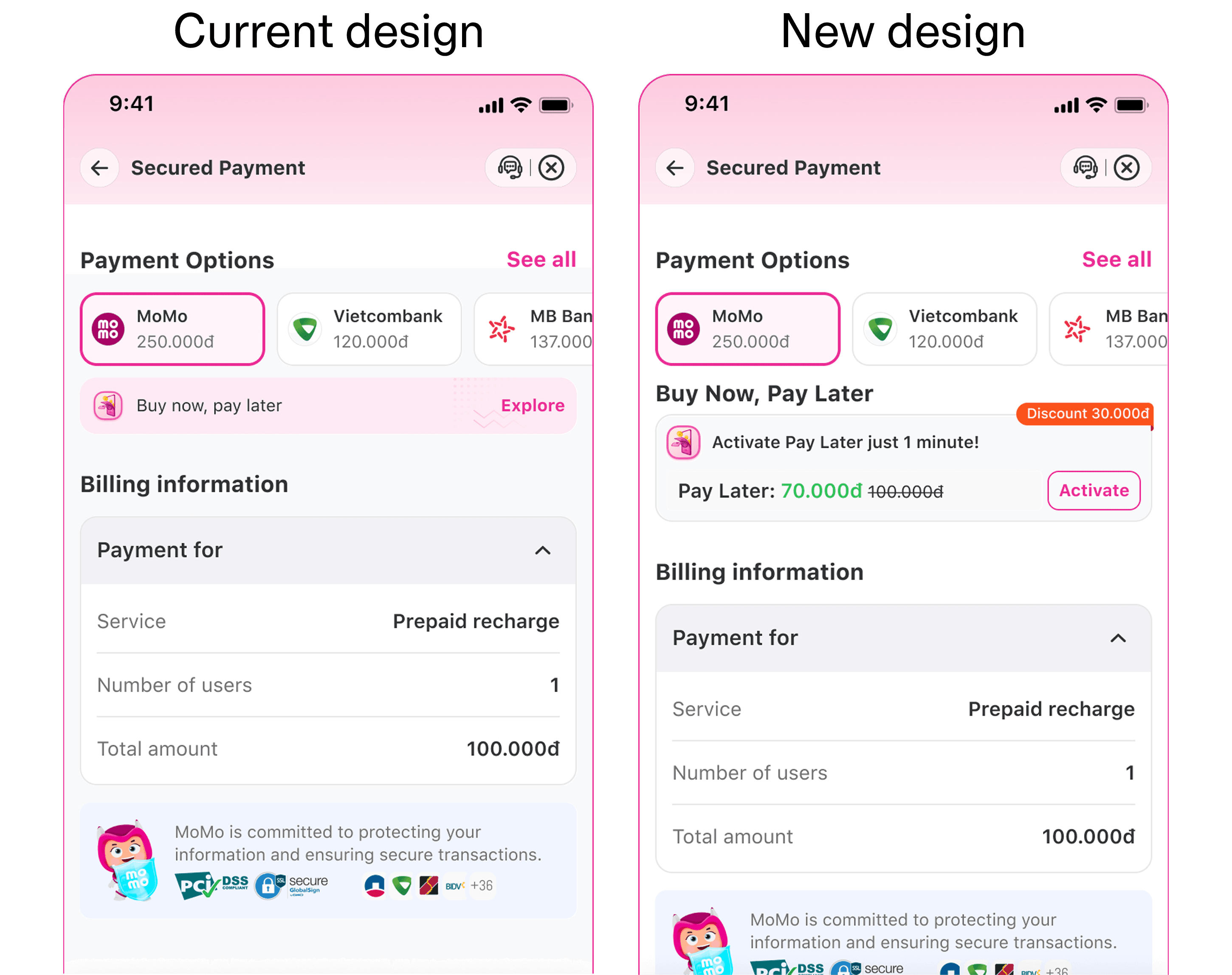
The Secured Payment screen was already being redesigned in another project, independent of our work.

Secured Payment Before and After revamp
Designing the Pay Later Treatment in new Secured Payment
A timely overlap: the Secured Payment redesign gave us the canvas to ship all 3 hypotheses at once

Redesign Pay Later options on New Secured Payment
Does the design solutions fulfill the initial goals set out?
A/B Testing & Usability Testing
🔍 To validate the new design, we ran a two-stage validation:
Usability Testing (n=30) — qualitative check on comprehension, task success, and friction before committing to engineering build
A/B Testing — quantitative validation of conversion impact at scale, gated on UT findings
UT acted as a low-cost filter: issues caught here saved A/B test cycles and engineering rework.
Usability Testing
Group 1: User does not have a Pay Later account
Number of testing users: 15
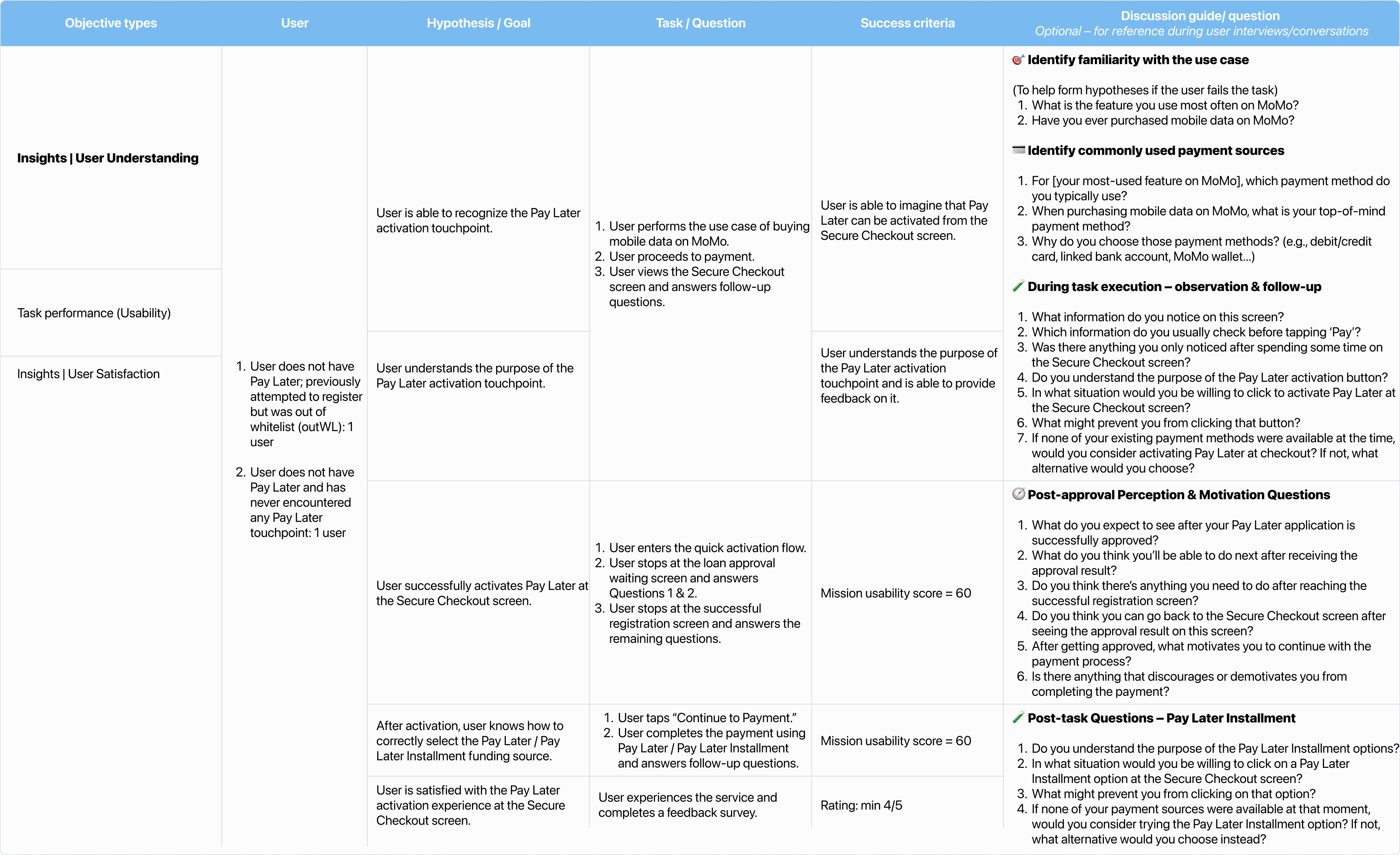
For users without an active Pay Later account, the research team divided them into two groups and evaluated their activation journey and experience at the Secure Checkout screen. based on the scenarios outlined in the table below.
🗝️ Key Finding
Disclaimer: Due to project confidentiality and participant privacy, the detailed UT report is not included here.
Pilot participants recognized the Pay Later touchpoint and completed activation. Participants rated satisfaction 4/5. Usability score (80/100).
Group 2: User has an active Pay Later account
Number of testing users: 15
For users who already have Pay Later, we conducted testing to observe how they select Pay Later and Pay Later Installment as payment methods, based on the scenarios outlined in the table below.

🗝️ Key Finding
Disclaimer: Due to project confidentiality and participant privacy, the detailed UT report is not included here.
Users could clearly distinguish and select between Pay Later and Installment options. While overall satisfaction was high (≥4/5), motivation to choose Installment depended on urgency or lack of other payment sources.
UT surfaced no blocking issues for the core activation and payment flows across both user segments. One area flagged for monitoring — Installment perceived value — was carried forward as a secondary metric in A/B testing rather than a redesign trigger. Design handed off to engineering for A/B build.
A/B Testing
With friction factors now validated, this second A/B test measured whether the full redesign — combining all three fixes — delivered results at scale.
Test setup
Cohort: 10% pilot traffic on Secured Payment
Duration: 28/04/2025 - 25/05/2025 (4 weeks)
Treatment: New Secured Payment design (incorporating credit limit visibility + promotion block + clear CTA + restructured placement)
Control: Existing Secured Payment UI
Counter metric (test-level): Overall Secure Checkout conversion rate must not materially decrease
Two hypotheses were analyzed within this single test, each with its own analysis window based on data sufficiency:
Hypothesis 1
Analysis window: 28/04 - 25/05 (full 4 weeks for activation rate sufficiency)
Hypothesis 1: For users whose transactions meet the eligibility criteria to open MoMo Pay Later, if they are informed about the product and its value proposition on the Secured Payment screen, they will be more likely to consider using it.
This can help encourage users to register for MoMo Pay Later and make payments using it as the funding source.
📊 Metrics
- Success Metric: Increase in the number of new MoMo Pay Later activations
- Counter Metric: Conversion rate of Secure Checkout must not decrease
Test scope: 10% traffic pilot on Secured Payment, mutually exclusive cohort
Methodology note: Traffic split handled by the Payment Core data team; detailed statistical design available on request.
With friction factors now validated, this second A/B test measured whether the full redesign — combining all three fixes — delivered results at scale.
Hypothesis 2
Analysis window: 28/04 - 18/05 (3 weeks; unlock event volume reached sufficiency earlier)
Hypothesis 2: For users with a locked MoMo Pay Later account, if they have a payment need and clearly see the value of this funding source at the Secure Checkout screen — along with a quick unlock option — they are more likely to consider unlocking and continuing to use Pay Later.
📊 Metrics
- Success Metric: Number of users who successfully unlock MoMo Pay Later
- Counter Metric: Conversion rate of Secure Checkout must not decrease
Test scope: 10% traffic pilot on Secured Payment, mutually exclusive cohort
Methodology note: Traffic split handled by the Payment Core data team; detailed statistical design available on request.
Data & Result

Disclaimer: To ensure confidentiality, the data has been blurred and adjusted.

Table 4: A/B Test Results
📊 Key Results Summary
What the test validated
Activation rate (H1): Eligible users activated Pay Later 17% more often in Treatment vs Control
Unlock rate (H2): Locked users unlocked Pay Later at a rate of 4.27% in Treatment, vs 0.22% in Control — moving an effectively buried flow into a visible one
Pay Later usage: Conversion rate rose +2.01% at the user level and +0.33% at the transaction level — both directions positive
Counter metric (Secure Checkout): Conversion held at 1.51% (transactions) with a -0.03% shift among users — no meaningful drop in the core checkout funnel
Viable solution to tackle the situation!
Design Solution
New Pay Later Touch Points
To drive MoMo Pay Later adoption, the design evolved from a passive discovery model to an action-oriented experience. By restructuring the information architecture and highlighting immediate value, we transformed the checkout screen into a powerful conversion touchpoint."
New Pay Later on Secured Payment


Project Impact
From A/B Testing to 8-Month Post-Launch Results
Pay Later Growth
Internal SoF Share
trending_up
% to
%
(+4.8 pp)
Shifted user behavior to high-margin funding sources.
Pay Later New Users
trending_up
~
business target met
Optimized touchpoints and reward flows drove full-year activation goal.
Figures adjusted to preserve confidentiality; magnitudes and directional trends reflect actual results.
What I’ve learned from this project
Key Takeaways
Key Takeaways
The proposed solution improves information clarity and supports Pay Later activation
User satisfaction with the experience remains high across both variants
A clear CTA and simplified flow help reduce friction during payment
Iterative testing (Usability Testing → A/B Testing) is key to validating long-term impact
Special thanks to all the team members who contributed to this project. Your collaboration made this possible. 🙏
Thank you for taking the time to explore my little world!
👉 Connect with me:
nguyenhoangkhoic3b@gmail.com