PARENTING APPLICATION
DayCon VN.
A parenting platform that pairs real experts, concrete development tracking, and supportive AI — designed to earn parents' daily return.
Not interested in reviewing the UX process?
Khoyy
UI/UX CASE STUDY
DayCon Inc.
My Role
Product Designer — own UX research, problem
framing, concept development, design UI design for DayCon 2.0.
Additional contributions
Visual system: defined illustration style, character design, and brand expression for v2.0. Product direction: collaborated with the founder on product strategy and scope decisions.
Team
DayCon was an early-stage startup. The v2.0 project ran with the founder (An Pham, AI/tech
lead) and 1–2 engineers. I was the sole design resource — research through interaction through
visual.
Note: Specific numbers in this case are kept approximate. Partner names and user counts reflect general scale; exact figures are held privately. The case focuses on design reasoning rather than business metrics, as the v2.0 phase ended before launch.



Explore the process
Project Brief
About DayCon
DayCon.ai is a Vietnamese parenting tech startup founded by An Pham, an AI specialist (ex-VP Technology at Hello Health Group). The product combines AI with expert knowledge to support families in tracking and shaping their child's development.
DayCon 1.0 shipped to production and grew a user base of several thousand organically. Two business problems surfaced: free-to-premium conversion was low, and users weren't returning to the app daily. This case is about v2.0 — a redesign built to address both.
The v2.0 work reached hi-fi prototype and qualitative validation before the company pivoted away from the maternal/child category. Details on outcome at the end of this case.

Base on Design Thinking
Design Process
Why we started from Test, not Empathize
Most Design Thinking cases start with Empathize. This one didn't. DayCon 1.0 was already live with several thousand users, meaning real usage behavior existed to study. Running a fresh Empathize round on a hypothetical user would have been weaker signal than testing existing users against the live product.
So we started at Test — interviewing current users about how they actually used DayCon 1.0 — then looped back to Define once the behavioral patterns were clear.

Khoyy
Nghia Dinh
An Pham

What are the factors responsible for the problems?
Survey & Testing
Desk Research - Avoid Bias
In Vietnam, the average age at first marriage is currently 27.2 - According to GOV
According to the results of the 2019 Population and Housing Census, women aged 25-29 have the highest birth rate. - Baochinhphu
Survey & Finding
350 surveys. Parents told us where they struggle:
%
child's behavior.
%
parenting/child-rearing
issues.
%
developmental
delays
User Testing Goals
Examine user reactions to DayCon 1.0 when using the key features of the app.
Gather suggestions and opinions from users to improve the core features of the app and develop new features that address users' daily jobs to be done, thereby encouraging daily use of the app.
Users Interview
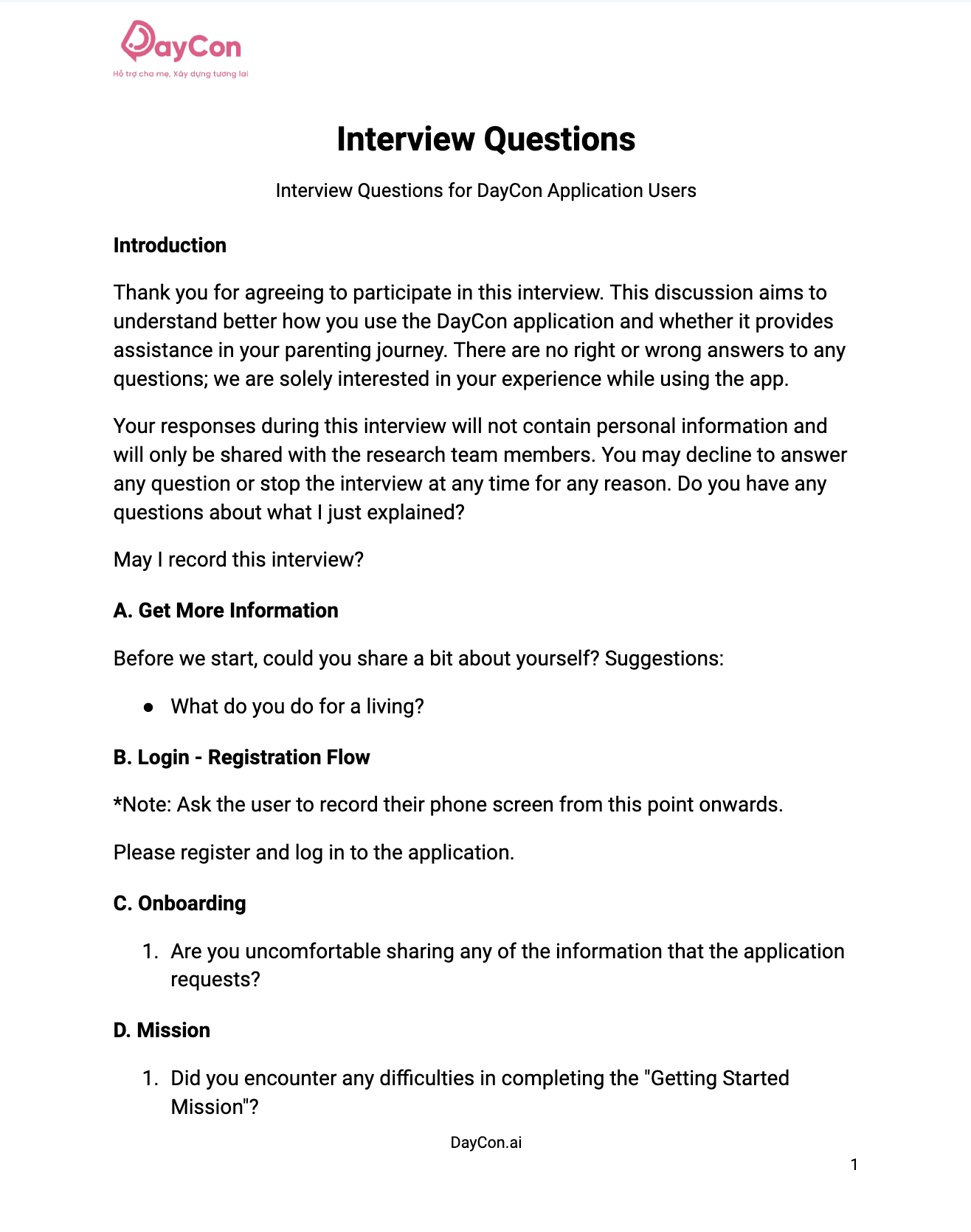
Based on the results of desk research, I sent interview invitations via email to current DayCon customers who are women aged from 25 to 29. After that I conducted interviews with 30 users over a week.
Research Approach
Who participated
30 users of DayCon 1.0, recruited via email from the active user base.
Filtered to mothers aged 25–29, the cohort with the highest birth rate in Vietnam (2019 Census).
Format
Short-form conversations, 10-15 minutes per session.
Conducted over 7 days, audio-recorded.
Focused on: how parents currently look for parenting information, how they used DayCon 1.0, and what they valued in the existing features.
What this research could and could not do
Given the short session length and the resources of an early-stage startup, this round could only catch recurring patterns — not deep behavioral insight or statistically generalizable findings.
Synthesis was light: I listened back through the recordings, pulled out phrases parents repeated, and clustered the friction points that showed up across most sessions. Speed over methodological rigor.
The themes that drove v2.0 were the ones appearing consistently across interviews and corroborated by two other sources: the founder's domain expertise in pediatric AI (ex-VP Technology at Hello Health Group), and desk research on child development frameworks used in Vietnam. Themes that only surfaced in a few sessions were logged but not used to drive scope.
Known limitations
The user base had already self-selected into the app. These insights reflect the behavior of current users, not the motivations of prospective ones — useful for the retention story, thin for the acquisition one.
Mothers only: in Vietnam, parenting decisions usually involve both parents; the father's perspective wasn't captured this round.
Short sessions: 10–15 minutes is enough to catch what parents say, not enough to get at what parents actually do.


What are the factors responsible for the problems?
Define
User Persona
The persona crystallized around one decision parents repeatedly described: when something about their child feels off, whose voice do they trust? Not peer forums, not AI summaries — they trust named experts with credentials. The persona anchors every subsequent feature decision to that trust hierarchy.

Customer Journey Map
The journey map surfaced a specific drop-off: parents opened DayCon to answer one question, got the answer, and closed the app — with no re-entry trigger until the next random question. The map made it clear that v2.0 needed to engineer return triggers, not rely on ambient need.

Problem Framing
The brief named two business problems: free users weren't converting to premium, and users weren't opening the app daily. After 30 interviews, both turned out to be the same story.
What that story is
DayCon 1.0 sold AI as its main value. But parents were direct in interviews: they don't trust AI enough to pay for it. What they're willing to pay for is real experts, and concrete tracking of how their child is developing.
The app was leading with its most abundant asset (AI) and burying its scarcest one (expert access) two layers deep.
Where this shows up
First — not converting - Free users tried the AI, found it okay but not worth paying for. The thing they said they would pay for — expert consultation, structured development tracking — existed in v1.0, but not where parents looked for it.
Second — not returning - The app was used like a dictionary. Parents opened it when a specific question came up, closed it when they had an answer. A few times a week, a few minutes each time. Subscription doesn't survive that pattern.
How this reframed the design direction
The team had been thinking "AI isn't good enough" and "paywall is in the wrong place." After the
interviews, the design question shifted — from "how do we sell AI better?" to "what should DayCon sell, and how does it earn a daily open?"
Translating research into product decisions
Ideate
From research to product decisions
Single source isn't enough. v2.0 scope sits at the intersection of four inputs — the moment all four pointed in the same direction, we knew we had the right concept.
1. Interview patterns — 30 mothers told us what v1.0 couldn't do for them. The recurring gap: tracking, not just content.
2. Survey patterns — 350 parents ranked their concerns. Behavior (24.6%), parenting (20.8%), and developmental delays (12.5%) all pointed back to one missing capability: a way to see whether the child is on track.
3. Founder's pediatric AI expertise — DayCon 1.0 already had a working AI layer. Consumer-grade AI had matured to the point where developmental screening could happen in-app, not in a clinic.
4. VN child development frameworks — The Ministry of Education's Circular on Child Development Standards gave us a credible, government-backed rubric. We didn't have to invent the milestones — we had to make them legible to parents.
Where all four overlap → v2.0 Scope.

Concept Development
Child development tracking (spider chart)
Maps a child's progress across the five developmental areas defined by Vietnam's Ministry of Education. The spider chart format came from child development research, not from user suggestion — parents in interviews said they wanted holistic tracking but didn't specify a format. I chose the spider chart because it collapses five dimensions into one scannable view, and because a "deviation from normal range" on any axis is the most natural reason to pull parents back — connecting tracking to retention.
Daily activity library
Short instructional videos tied to each developmental area, giving parents something concrete to do with their child each day. Chosen over AI-generated activities because pre-produced expert videos carry the signal of "there's a real person behind this" — parents in interviews explicitly said they trusted anything that "felt AI-generated" less.
Expert directory and services
A directory of parenting experts, each tagged by developmental area. Experts can publish courses and offer consultations (offline, online, therapy) through the platform. Chosen as the monetization backbone because it answers the "parents pay for experts, not AI" signal directly — and because it creates a supply-side network effect, a different defense than the AI-as-product model.
Height & weight tracking against WHO standards
A lightweight, high-frequency measurement habit — enough to earn a daily open without parents having to think about what to check. Chosen specifically for retention: it answers "what should the app earn a daily open with?" using a task parents already do but lack structure for.
What we considered and set aside
Peer community features (parent forums, group chat) came up but were set aside. Interviews suggested parents valued expert authority over peer consensus; investing in community before establishing expert trust would have diluted the core positioning.
Information Architecture
After reporting the research results and proposing ideas to stakeholders, we have decided to develop DayCon 2.0 with significant changes


User Flow
Simplified User Journey, here is Key User Flows of DayCon 2.0


New Homepage
In v1.0, the homepage led with an AI chat entry — which matched v1.0's positioning but sent parents straight into the asset they trusted least. The v2.0 homepage instead surfaces the four retention features (tracking, daily activity, expert directory, WHO chart) at the top, with AI support moved to a secondary layer inside each feature. The homepage became a daily dashboard rather than an AI entry point.
Draft some viable solutions to tackle the situation!
Visual Design
DayCon 1.0
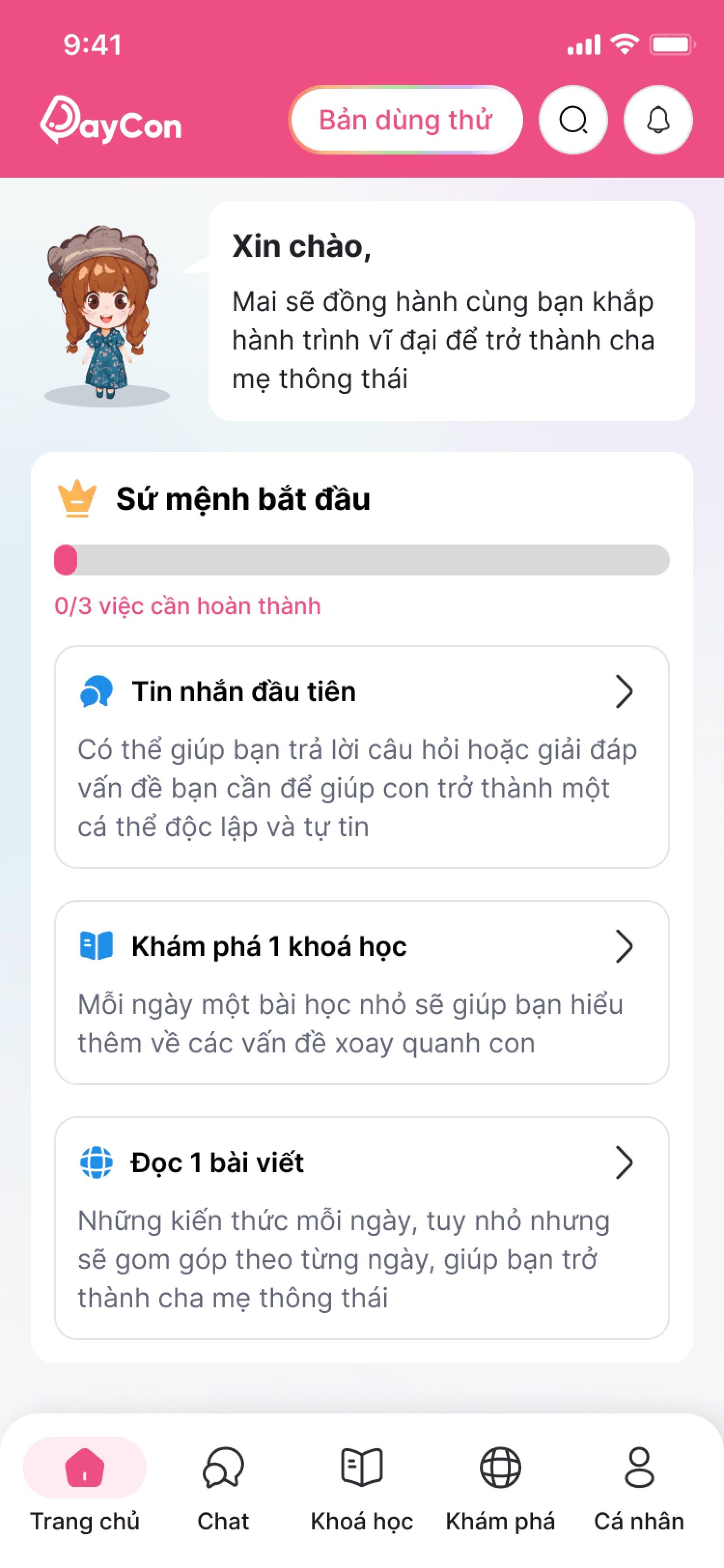
DayCon 1.0 screens — included here as the baseline. Note how AI chat takes primary screen real estate across the app; the v2.0 redesign inverts this hierarchy.


DayCon 2.0
Some design screens of DayCon 2.0.
Login - Register - Onboarding
Onboarding captures the child's age and developmental stage first — before anything else. This seeds the spider chart and WHO tracking from day one, so parents see personalized data on their first home screen visit, not after a cold start.


Some main screens
The home screen surfaces the four retention features as the primary layout — spider chart, today's activity, expert access, WHO tracking. AI support sits inside each feature rather than owning a primary surface.


Expert
Expert profiles lead with credentials and developmental-area tags — so parents can match an expert to the specific axis of the spider chart they're concerned about. Booking flow is the monetization backbone identified in concept development.


Premium Courses
Premium courses are authored by the experts in the directory — not by DayCon as platform. This keeps the trust signal ("a named expert taught this") consistent with the broader monetization logic: parents pay for expert authority, not platform-generated content.


Logo DayCon
The wordmark turns the "D" into an egg-and-seed mark — a visual anchor for the parenting and early-development category without leaning on generic childcare clichés (stars, hearts, alphabet blocks). The rounded geometry carries through the illustration system and the UI's card corners.


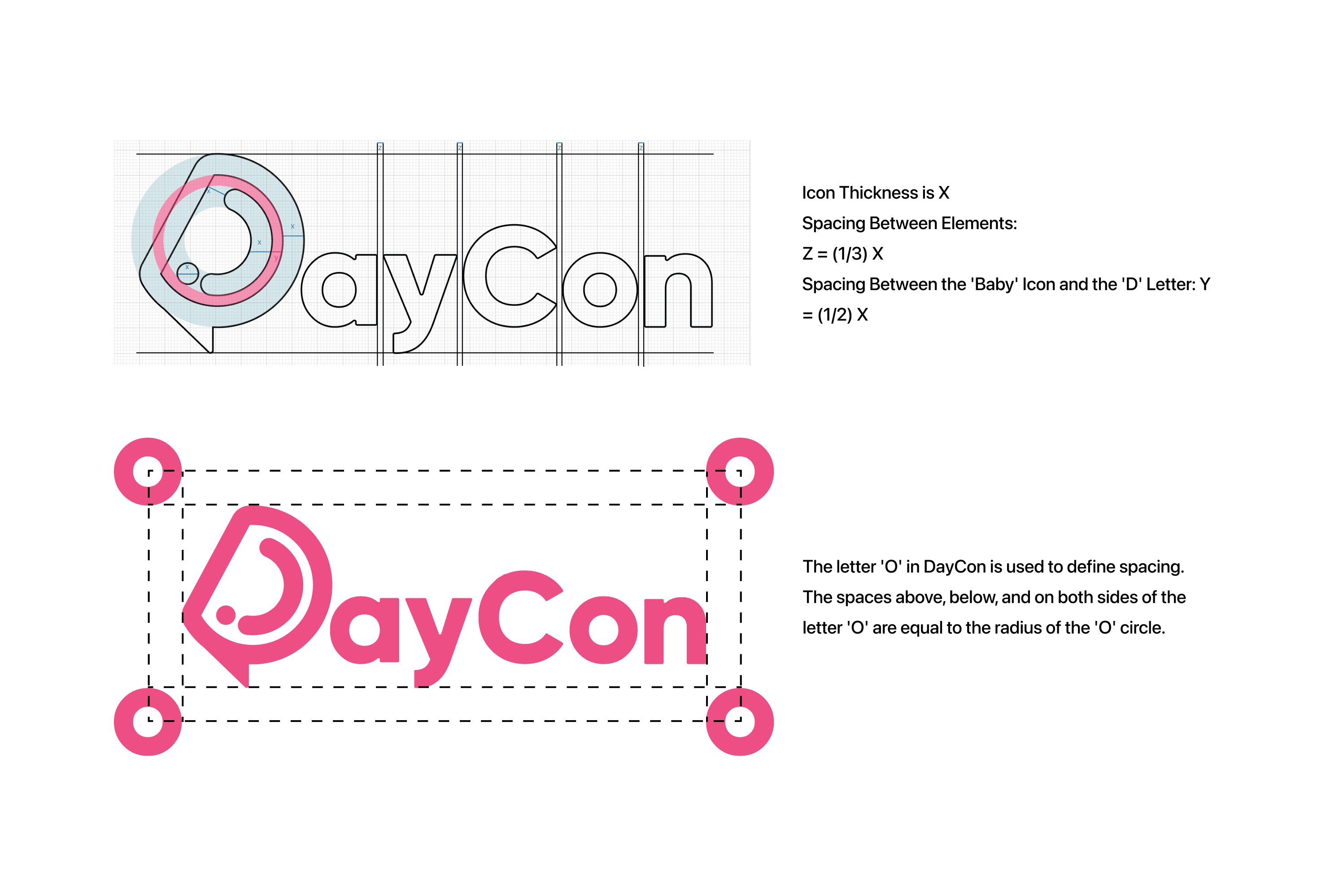

Illustration Characters
Illustration system — a family of four characters (Dad, Mom, Son, Daughter) woven through the user journey. The warmth of the illustration softens the clinical feel of developmental tracking data, keeping daily measurement habits from feeling like homework.

What we achieve in this verson
Project Outcome
About DayCon 1.0
DayCon 1.0 was live in production with several thousand organic users when this project started. This case is about v2.0 — a redesign that reached hi-fi prototype and qualitative validation, but the company pivoted away from the maternal/child category before it could ship.

External validation
Startup Wheel 2024 — Top 50 Vietnam Track.
DayCon 2.0 advanced to the Top 50 of the Vietnam Track at Startup Wheel 2024, one of Southeast Asia's longest-running startup competitions (2,345 applicants across 26 countries that year). The judging criteria weight product-market fit signal, founding team quality, and differentiation — external evidence that the reframe read as credible beyond our team.
Partner interest before the pivot
Before the company's pivot, parenting experts and kindergartens engaged in integration discussions following demo sessions with the v2.0 prototype (partner logos shown below). These conversations didn't reach formalized partnerships — DayCon paused the category before terms were settled.
Current status
The company subsequently pivoted away from the maternal/child development category. DayCon 2.0 did not ship to production. The work in this case is the output of the design phase: problem reframe, concept development, hi-fi prototype, and external validation — not a launched business outcome.
What this case demonstrates
This is a case about reframing a problem and developing a concept. The contribution is in identifying the right problem to solve (retention-as-daily-ritual, not AI quality) when v1.0 had organic traction but stalled at monetization — and a reframe that earned competition recognition and partner engagement before the pivot.


Thank you for taking the time to explore my little world!
👉 Connect with me:
nguyenhoangkhoic3b@gmail.com